

Every cafe owner knows roughly what a cappuccino sells for. Far fewer know exactly what it costs to make. That gap is where profit quietly leaks away: a little extra milk in every cup, a price that hasn't moved since coffee beans went up, a burger that sells well but barely makes money.
This guide shows you how to work out the real food cost of every item on your menu, what percentage to aim for, and how to keep it under control week after week.
What food cost means
Food cost is the cost of the ingredients that go into one serving of a dish. It does not include rent, salaries or electricity; those are separate. Keeping ingredients separate lets you see which dishes earn their place on the menu.
Most owners track it in two ways:
- Food cost per dish: what one plate or one cup costs you in ingredients, in rupees.
- Food cost percentage: that cost as a share of the selling price (before GST).
The food cost formula
For a single dish:
Food cost % = (ingredient cost of one serving ÷ selling price before GST) × 100
For the whole cafe over a period, such as a month:
Food cost % = (opening stock + purchases − closing stock) ÷ food sales before GST × 100
The second formula tells you what actually happened, including wastage, over-portioning and anything that went missing. The first tells you what should happen. The difference between the two is the money you can win back.
Worked example: a cappuccino
Suppose your recipe for one cappuccino is 18 g of coffee beans, 180 ml of milk and 5 g of sugar. First, turn your purchase prices into a cost per gram or millilitre:
- Coffee beans bought at ₹800 per kg → ₹0.80 per gram → 18 g costs ₹14.40
- Milk bought at ₹60 per litre → ₹0.06 per ml → 180 ml costs ₹10.80
- Sugar bought at ₹45 per kg → ₹0.045 per gram → 5 g costs ₹0.23
Ingredient cost of one cappuccino: ₹14.40 + ₹10.80 + ₹0.23 = ₹25.43. Add the cup and lid for takeaway if you want the full picture.
If the menu price is ₹140 before GST, the food cost percentage is 25.43 ÷ 140 × 100 = about 18%. Beverages usually run a lower food cost than food, which is why they matter so much to a cafe's margin.
Worked example: a veg burger
A burger has more parts, so list each one: bun, patty, cheese slice, lettuce, tomato, sauce, plus the oil used to fry the patty. Suppose the parts add up to ₹52 per burger and the price is ₹160 before GST.
Food cost: 52 ÷ 160 × 100 = 32.5%.
That is not wrong in itself, but now you can compare. If the burger and the cappuccino sell in similar numbers, each cappuccino earns you about ₹115 over ingredients while each burger earns about ₹108. Knowing this changes which item you put on the counter board.
What food cost percentage should a cafe aim for?
There isn't a single right number, because it depends on your menu mix and pricing. As a rough guide, many cafes and restaurants aim for a total food cost somewhere between about 25% and 35% of food sales. Coffee and tea tend to sit well below that, while dishes with paneer, chicken or cheese usually sit above it.
More useful than chasing a benchmark is tracking your own number every month. If your food cost percentage climbs from 29% to 33% while prices stayed the same, something has changed: supplier prices, portions, wastage or stock going missing.
Seven ways to bring food cost down
- Write a recipe for every item. If the recipe exists only in the cook's head, portions drift. Weigh it once, write it down and train to it.
- Update costs when purchase prices change. Use the weighted average of what you actually paid, not the price from six months ago.
- Buy in the unit you use. If flour comes in 25 kg bags but recipes use grams, convert once so the cost per gram is always right.
- Record wastage the moment it happens. Spilt milk and burnt patties are real costs. Writing them down at the end of the day loses the reason.
- Count stock once a month. Comparing what you should have with what is on the shelf is the only way to see shrinkage.
- Re-price slow, low-margin items. An item that sells rarely and earns little is a candidate for a new price, a smaller portion or removal.
- Push your high-margin items. Put them first on the menu, train staff to suggest them, and build combos around them.
Doing it without a spreadsheet
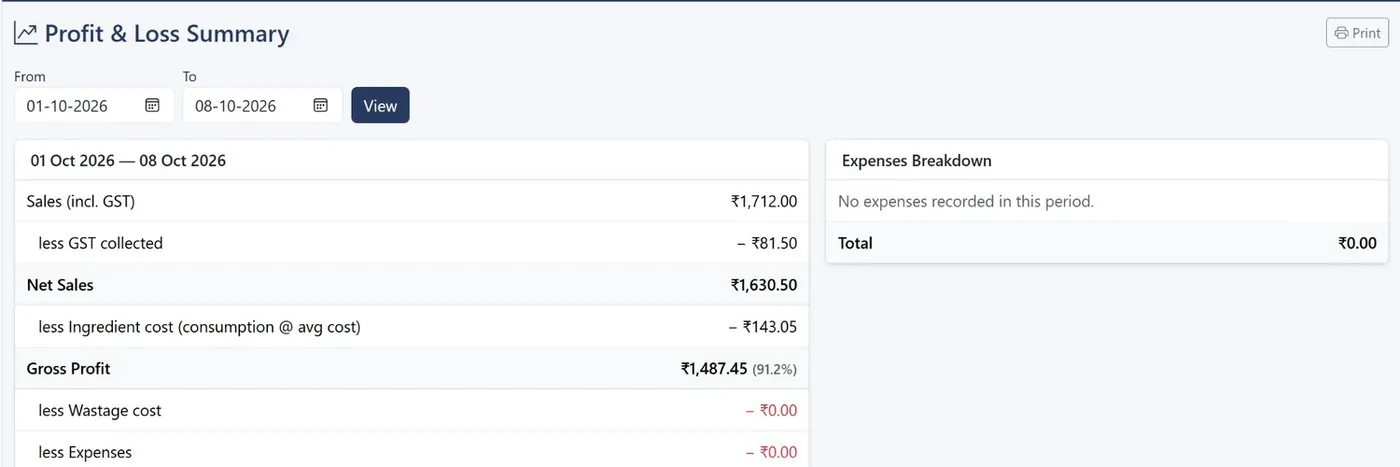
All of this is possible with a notebook and a calculator, but it is hard to keep up when you sell hundreds of items a day. In KwickCafe, you add a recipe to each menu item once. Every bill then deducts the ingredients at weighted average cost, so the food cost of every dish stays current, the Profit & Loss report shows gross profit after ingredients, and the shrinkage detector compares your monthly count with what the recipes say you used.
If you'd like to see this with your own menu, book a free demo and we'll set up two or three of your recipes on the call.
Quick checklist
- Recipe written and weighed for every menu item
- Cost per gram or ml worked out from the latest purchase prices
- Food cost % calculated per dish and for the whole month
- Wastage recorded with a reason as it happens
- Monthly stock count, compared against expected usage
- Prices reviewed for low-margin items every quarter